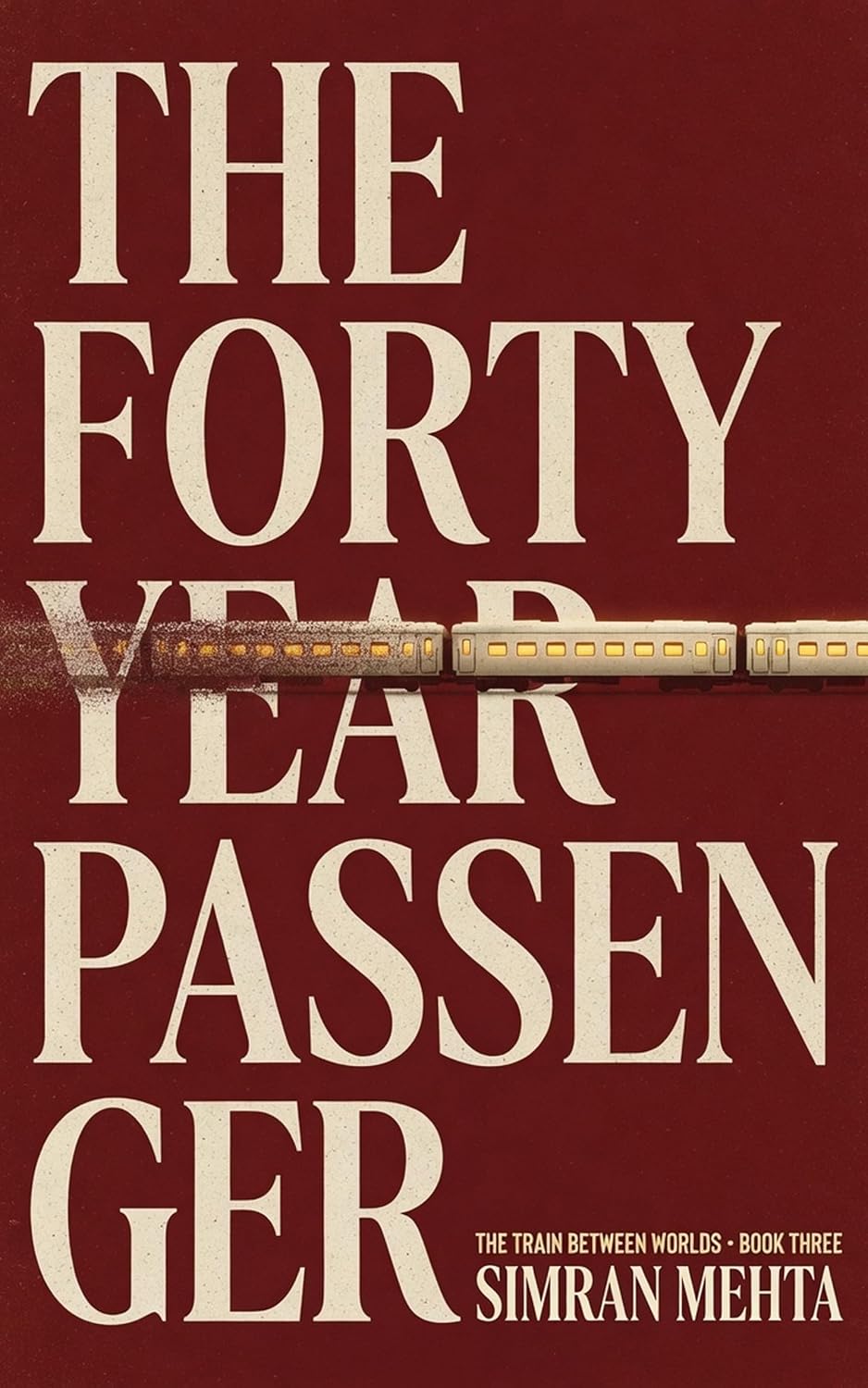
Book Three · The Train Between Worlds
The Forty-Year Passenger
A novel of a lost brother, a vanished mother, and the woman who has been mapping the train since 1981.
A standalone novel — new readers can start here
Free to borrow with Kindle Unlimited
For fifteen years, Abel Quist walked past a woman carrying an empty bucket. He never once looked at her face.
Nobody knows how they get on the train. They wake in a carriage with no destination board and no memory of boarding, and they stay, because every door aboard costs the same thing to open: one true memory of the person you'd go back for.
Abel has been aboard longer than almost anyone, and he has opened eleven doors in fifteen years. He has spent that time mapping the train instead — counting corridors, logging what he sees, and carrying tea every morning to a brother who no longer knows they are related.
Then he finds a surveyor's mark cut into a wall, dated 1981. Someone has been mapping this train for forty-five years. Someone far better at it than he is.
Her name is Verity Sloane, and she boarded with nothing the train would accept — no husband, no child, nobody in the world she would return for. Destitute in the only currency that exists aboard. So she worked out that she could spend other people instead. Four hundred and eleven of them, recorded in a neat upright hand, in forty-three cloth-bound notebooks: a name, a number, a date, and no word anywhere for what was taken.
One of the entries is his brother. And ten years earlier, in a different notebook on the same shelf, is a woman with no name who came aboard searching for her son — and who would not put down her bucket. She had been four carriages away from him for eleven years.
What follows is not a rescue. It is an argument between a woman who spent four hundred and eleven strangers to answer a question, a woman who spends herself to save them, and a man who has never spent anything at all and has been ashamed of it for fifteen years — and only one of them turns out to be right.
What to expect
- Read it if you liked
- Piranesi, The Ten Thousand Doors of January, Elizabeth Is Missing
- Central question
- Is it worse to spend people, or to spend nothing and call it decency?
- Tone
- Cool, exact, morally argumentative. The antagonist is never quite a villain.
- Point of view
- Abel Quist, with Verity Sloane's notebooks threaded through.
- Content notes
- Dementia, a sibling who no longer recognises the narrator, a missing son, exploitation of vulnerable people.
- Formats
- Kindle and paperback. Free to borrow with Kindle Unlimited.
- Reading order
- Book Three, and the one most often recommended as a starting point.
FAQ
Questions readers ask
Do you have to read The Train Between Worlds books in order?
No. All three novels share a world, a currency and a train, but not a plot. Each one is written to work as a complete first book, and none of them spoils the others. Reading in publication order gives you the world in the order it was invented; starting anywhere else costs you nothing.
What is The Train Between Worlds actually about?
A train nobody remembers boarding, with more carriages than anyone has counted. Passengers stay because leaving is expensive: every door aboard costs one true memory of the person you would go back for. Not a fact or a date — the kind of memory you can walk around inside. The series follows three people paying that fare for very different reasons.
Is The Train Between Worlds free on Kindle Unlimited?
Yes. All three novels are free to borrow with a Kindle Unlimited subscription, and each can also be bought outright on Kindle. The Memory Fare and The Forty-Year Passenger are available in paperback too.
What should I read after The Midnight Library?
It depends which part of it you loved. If it was the premise — a place outside life where you get to examine your choices — you want speculative fiction with a clean central rule. If it was the feeling, you want quiet, consoling novels about second chances. Those are two different shelves, and the read-alike lists usually confuse them.
What are liminal space books?
Fiction set in places built for passing through and then never left — corridors, waiting rooms, stairwells, transit that never arrives. The defining feature is not horror but suspension: the architecture is doing something the characters cannot explain, and the rules of the place matter more than the plot.
Are there novels set entirely on a train?
A few. Most “train books” are murder mysteries that use a carriage as a locked room for a few hundred pages, or travel memoirs about real railways. Novels where the train is the whole world — no destination, no getting off — are much rarer, and they behave very differently.
What is the best novel about dementia?
There is no single answer, because readers come to these books for opposite reasons — some want the illness rendered accurately from the inside, some want the caregiver's side, and some want a story that is about forgetting without being a medical narrative at all. The right book depends on which of those you need.
Which book is about a mother searching for her missing daughter?
The Memory Fare, Book Two. Cora Marsh has spent six years at a railway lost property office looking for anything of her daughter's. When she finally boards the train on purpose, she learns that every door she opens to search for June costs her one real memory of her — and she will never know which one she paid.