Read-alike guide
Books Like Piranesi
Susanna Clarke's novel does three separate things brilliantly, and most read-alike lists only match one of them. Work out which one you're chasing before you pick your next book.
Short answer
If it was the architecture you loved, read I Who Have Never Known Men or House of Leaves. If it was the voice — that patient, grateful, careful narrator — read The Third Policeman or The Starless Sea. If it was the slow realisation that the narrator has been lied to, read Annihilation or The Ten Thousand Doors of January.
The usual problem with Piranesi recommendations is that people reach for fantasy, and Piranesi is barely a fantasy novel. It is a book about a man keeping meticulous journals inside a building that should not exist, being slowly and kindly deceived by the only other person there.
Take those three elements apart and you get three different shelves. Below, each book is tagged with the part of Piranesi it actually replicates — so you can pick by what you're missing rather than by genre.
Seven novels for Piranesi readers
-
I Who Have Never Known Men
The architectureThirty-nine women and one girl in a cage underground, with no explanation ever offered — not to them, not to you. The closest any novel comes to Piranesi's central discipline: a narrator who catalogues an incomprehensible world without ever being handed the reason for it. Bleaker than Clarke, and unforgettable.
-
House of Leaves
The architectureA house measurably larger on the inside than the outside, documented by people who each go slightly mad doing it. The typography is a gimmick until it isn't. Read it for the same reason you read Piranesi: the pleasure of watching someone try to make a floor plan of something that refuses to hold still.
-
The Third Policeman
The voiceA courteous, faintly ridiculous narrator explains a countryside that does not obey physics, complete with footnotes on a fictional philosopher. It has Clarke's exact trick of a narrator whose calm politeness is the scariest thing on the page.
-
Annihilation
The betrayalAn expedition into Area X, led by people who know more than they are saying. The tower that goes down instead of up is the closest thing in fiction to the Halls. Where Piranesi is warm, this is cold — but the structure of the deception is the same.
-
The Ten Thousand Doors of January
The betrayalA girl in a collector's house finds a book that turns out not to be fiction, and discovers her guardian has been managing her understanding of the world. The warmest book on this list, and the best match for readers who loved that Piranesi ends in kindness rather than horror.
-
The Starless Sea
The voiceAn underground library of nested stories, doors painted on walls that open anyway, and a narrator moving through it with the same reverence Piranesi shows the Halls. Plot is not the point; being inside the place is.
-
The Castle
The architectureThe ancestor of all of these. A man tries to reach an institution that is always one procedure away, in a village whose rules everyone else seems to understand. Unfinished, and better for it.
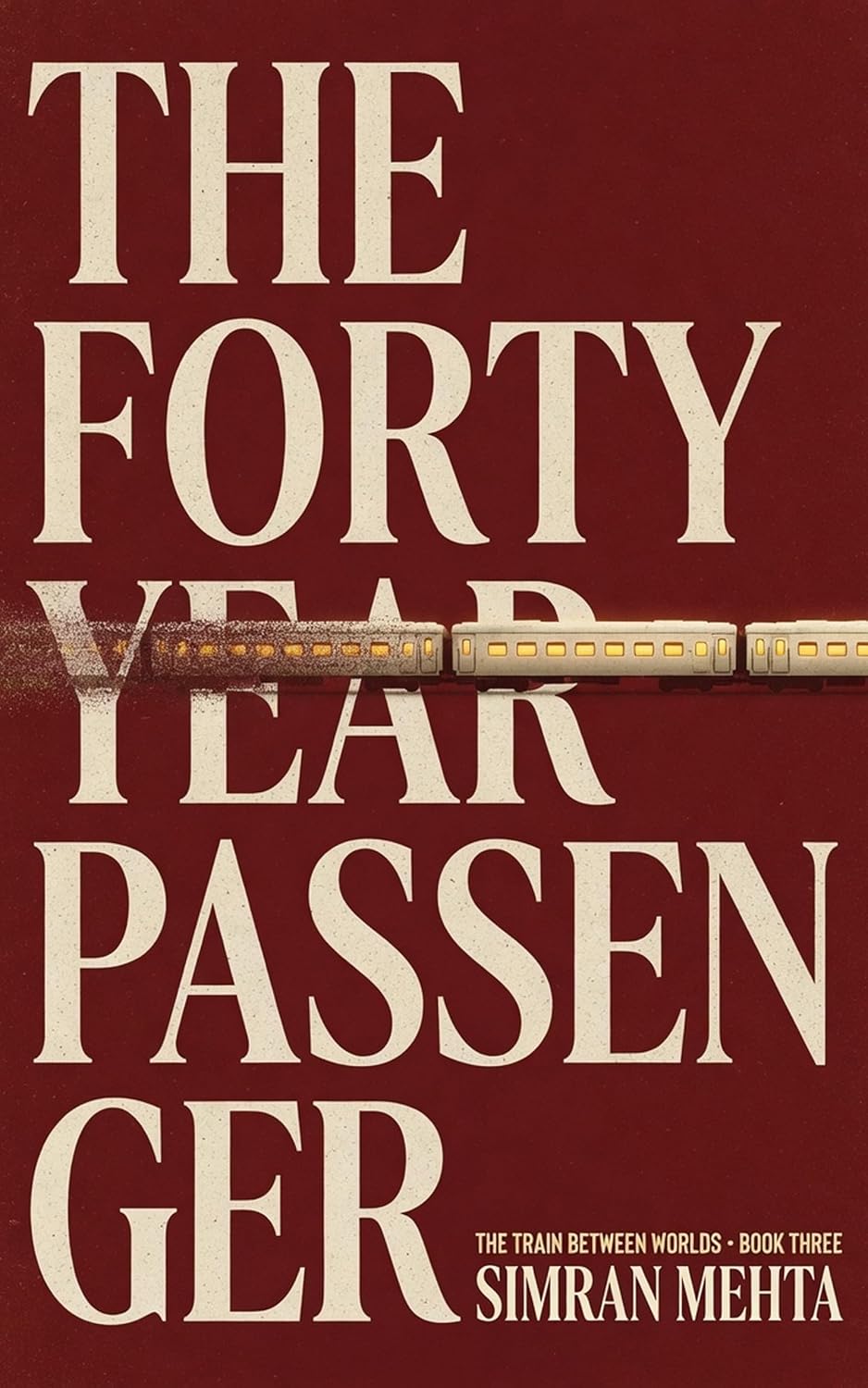
Book Three · The Train Between Worlds
The Forty-Year Passenger
A novel of a lost brother, a vanished mother, and the woman who has been mapping the train since 1981.
If what you want is specifically the mapping — the journals, the numbered halls, the person who has been there far longer and is not telling you everything — this is the book on this site to start with.
Abel Quist has spent fifteen years counting corridors on a train with more carriages than anyone has ever reached the end of. Then he finds a surveyor's mark dated 1981, and learns that Verity Sloane has been mapping it for forty-five years, in forty-three cloth-bound notebooks, and that one of the entries is his brother.
A standalone novel — new readers can start here
What to expect from The Forty-Year Passenger
Where it lines up with Piranesi, and where it deliberately doesn't:
- Same as Piranesi
- An impossible structure documented by hand. A narrator who catalogues rather than escapes. A second person who has been there much longer.
- Different from Piranesi
- The deception is not kind. Verity Sloane knows exactly what she is doing and will argue her case.
- Tone
- Cool and exact rather than luminous. Clarke's book forgives; this one puts the question to a jury.
- Content notes
- Dementia, a sibling who no longer recognises the narrator, exploitation of vulnerable people.
- Reading order
- Book Three, written as a standalone. Most Piranesi readers start here.
- Formats
- Kindle and paperback. Free to borrow with Kindle Unlimited.
FAQ
Questions readers ask
Do you have to read The Train Between Worlds books in order?
No. All three novels share a world, a currency and a train, but not a plot. Each one is written to work as a complete first book, and none of them spoils the others. Reading in publication order gives you the world in the order it was invented; starting anywhere else costs you nothing.
What is The Train Between Worlds actually about?
A train nobody remembers boarding, with more carriages than anyone has counted. Passengers stay because leaving is expensive: every door aboard costs one true memory of the person you would go back for. Not a fact or a date — the kind of memory you can walk around inside. The series follows three people paying that fare for very different reasons.
Is The Train Between Worlds free on Kindle Unlimited?
Yes. All three novels are free to borrow with a Kindle Unlimited subscription, and each can also be bought outright on Kindle. The Memory Fare and The Forty-Year Passenger are available in paperback too.
What should I read after The Midnight Library?
It depends which part of it you loved. If it was the premise — a place outside life where you get to examine your choices — you want speculative fiction with a clean central rule. If it was the feeling, you want quiet, consoling novels about second chances. Those are two different shelves, and the read-alike lists usually confuse them.
What are liminal space books?
Fiction set in places built for passing through and then never left — corridors, waiting rooms, stairwells, transit that never arrives. The defining feature is not horror but suspension: the architecture is doing something the characters cannot explain, and the rules of the place matter more than the plot.
Are there novels set entirely on a train?
A few. Most “train books” are murder mysteries that use a carriage as a locked room for a few hundred pages, or travel memoirs about real railways. Novels where the train is the whole world — no destination, no getting off — are much rarer, and they behave very differently.
What is the best novel about dementia?
There is no single answer, because readers come to these books for opposite reasons — some want the illness rendered accurately from the inside, some want the caregiver's side, and some want a story that is about forgetting without being a medical narrative at all. The right book depends on which of those you need.
Which book is about a mother searching for her missing daughter?
The Memory Fare, Book Two. Cora Marsh has spent six years at a railway lost property office looking for anything of her daughter's. When she finally boards the train on purpose, she learns that every door she opens to search for June costs her one real memory of her — and she will never know which one she paid.