Setting guide
The Best Books Set on a Train
A train is a closed world that keeps moving — which is why crime writers love it, and why almost nobody uses it for anything else.
Short answer
For the classic locked-room mystery, read Murder on the Orient Express or Stamboul Train. For psychological suspense, Strangers on a Train. For real railways, The Great Railway Bazaar. For the rarer kind where the train is the entire world and nobody gets off, Snowpiercer.
Search for novels set on trains and you get three very different things stacked on top of each other: golden-age crime using a carriage as a locked room, travel writers riding real lines, and children's picture books.
What almost nobody writes is the fourth kind — the train as the whole setting, with no station at either end. Those books behave completely differently, because the usual engine of a train story (we arrive, and then something happens) has been removed.
Seven books set on a train
-
Murder on the Orient Express
Locked roomThe one everyone means. A snowdrift halts the train, a passenger is dead, and the murderer is definitionally still aboard. The carriage is not decoration — the confined cast is the entire mechanism of the puzzle.
-
Stamboul Train
Locked roomGreene's early novel, set across three days on the Orient Express between Ostend and Istanbul. Less puzzle, more pressure: a handful of strangers whose lives collide because the train won't let them get away from each other.
-
Strangers on a Train
SuspenseTwo men meet in a carriage and one proposes they swap murders. Only the opening is on the train, but that scene defines the book — the specific intimacy of telling a stranger something because you'll never see them again.
-
Snowpiercer
The whole worldThe last of humanity on a train that circles a frozen earth forever, stratified by carriage. The original French graphic novel, sparer and bleaker than the film. The purest example of a train used as a complete society rather than a journey.
-
The Girl on the Train
SuspenseRachel watches the same houses from the same commuter service every day, until she sees something she shouldn't have. The train here is a viewing platform rather than a setting — but the repetition of the route is doing real work.
-
Night Train to Lisbon
The journeyA Swiss classics teacher abandons his life mid-lesson and boards a train to Portugal on the strength of a book. Philosophical, slow, and about the decision to leave rather than the destination.
-
The Great Railway Bazaar
Non-fictionFour months by rail from London to Japan and back on the Trans-Siberian. Theroux is often unkind about the people he meets, which is exactly why it reads as true. Still the best railway travel book there is.
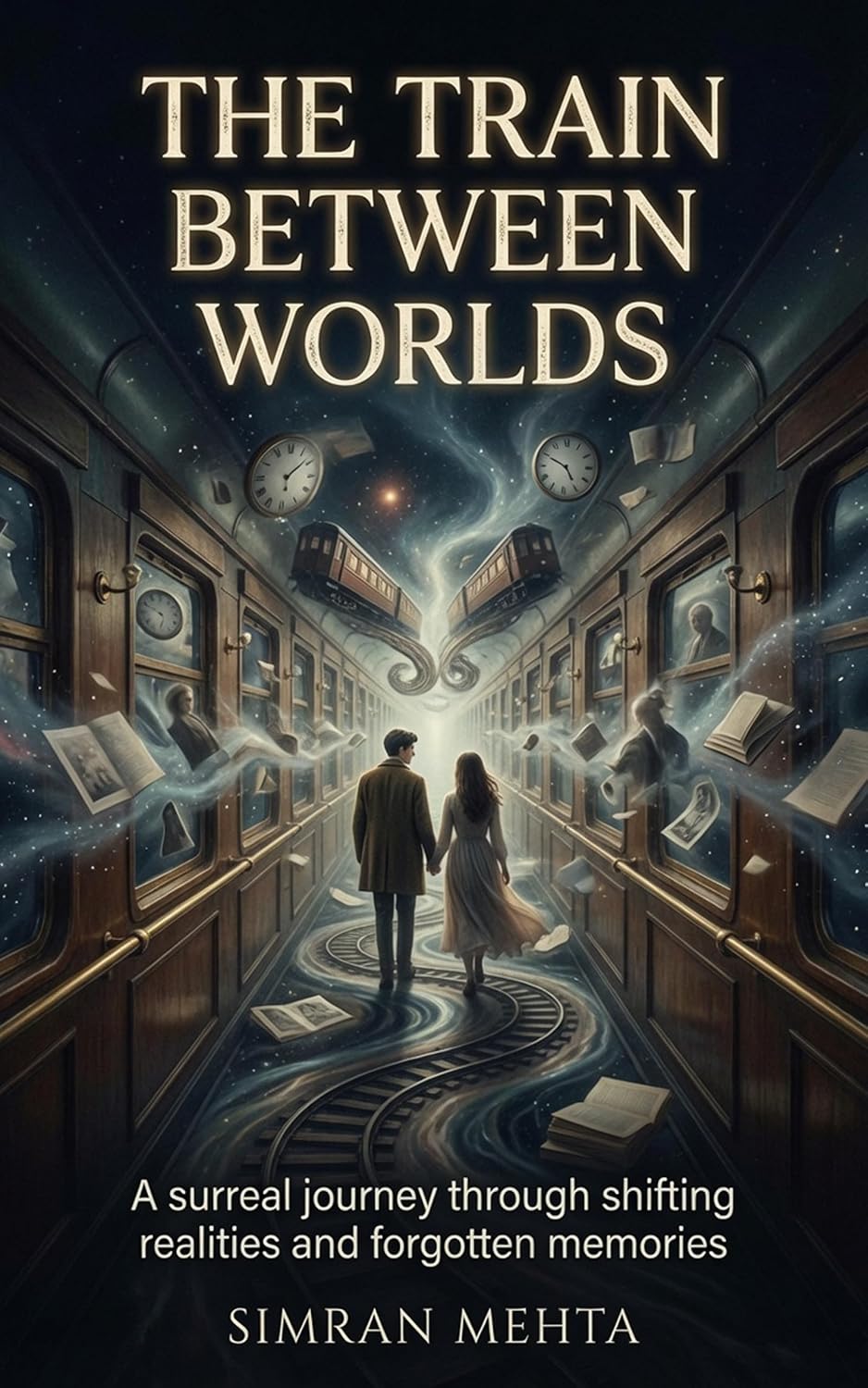
Book One · The Train Between Worlds
The Train Between Worlds
Lost on an endless train where realities blur, memories surface, and every choice reveals who you truly are.
This series belongs to the fourth category — the one almost nobody writes.
There is no station at either end. Nobody remembers boarding, no one has ever counted the carriages, and the only way off is through a door that charges you a memory to open. Across three novels the train is not a place where the story happens; it is the thing the story is about.
Where the line begins — a complete story in itself
What to expect from The Train Between Worlds
How it differs from every other book on this page:
- Not a mystery
- There is no detective and no murder to solve. The question is what the train is and what it wants.
- Not a journey
- No destination board, no arrival, no confirmation it is even moving.
- The rule
- Every door aboard costs one true memory of the person you'd go back for.
- Closest comparison
- Snowpiercer for the closed world, Piranesi for the tone.
- Three standalone novels
- Book One is surreal, Book Two is a mother searching for her daughter, Book Three is an argument about who deserves to be spent.
- Formats
- Kindle throughout; paperback for Books Two and Three. Free on Kindle Unlimited.
FAQ
Questions readers ask
Do you have to read The Train Between Worlds books in order?
No. All three novels share a world, a currency and a train, but not a plot. Each one is written to work as a complete first book, and none of them spoils the others. Reading in publication order gives you the world in the order it was invented; starting anywhere else costs you nothing.
What is The Train Between Worlds actually about?
A train nobody remembers boarding, with more carriages than anyone has counted. Passengers stay because leaving is expensive: every door aboard costs one true memory of the person you would go back for. Not a fact or a date — the kind of memory you can walk around inside. The series follows three people paying that fare for very different reasons.
Is The Train Between Worlds free on Kindle Unlimited?
Yes. All three novels are free to borrow with a Kindle Unlimited subscription, and each can also be bought outright on Kindle. The Memory Fare and The Forty-Year Passenger are available in paperback too.
What should I read after The Midnight Library?
It depends which part of it you loved. If it was the premise — a place outside life where you get to examine your choices — you want speculative fiction with a clean central rule. If it was the feeling, you want quiet, consoling novels about second chances. Those are two different shelves, and the read-alike lists usually confuse them.
What are liminal space books?
Fiction set in places built for passing through and then never left — corridors, waiting rooms, stairwells, transit that never arrives. The defining feature is not horror but suspension: the architecture is doing something the characters cannot explain, and the rules of the place matter more than the plot.
Are there novels set entirely on a train?
A few. Most “train books” are murder mysteries that use a carriage as a locked room for a few hundred pages, or travel memoirs about real railways. Novels where the train is the whole world — no destination, no getting off — are much rarer, and they behave very differently.
What is the best novel about dementia?
There is no single answer, because readers come to these books for opposite reasons — some want the illness rendered accurately from the inside, some want the caregiver's side, and some want a story that is about forgetting without being a medical narrative at all. The right book depends on which of those you need.
Which book is about a mother searching for her missing daughter?
The Memory Fare, Book Two. Cora Marsh has spent six years at a railway lost property office looking for anything of her daughter's. When she finally boards the train on purpose, she learns that every door she opens to search for June costs her one real memory of her — and she will never know which one she paid.